
A client asks why cash is tight. You review the statements, chase down the explanation, talk through the options and check back the following week. That is advisory work. If the agreement only covers bookkeeping, you may be doing it without a defined scope or a separate fee.
At Day Zero, packaging and pricing that work was one of the questions in the room. The answer starts before you choose a monthly number: decide what the client is buying, what you will deliver and how you will keep the engagement within its boundaries.
Know your floor. Price the engagement. Then have a repeatable way to deliver it. Here is a monthly scope you can adapt, a fee example you can work through and the first-month workflow after the client says yes.
Package a decision service, not unlimited access
A client is not buying the privilege of watching you open financial reports. The service is helping them understand a pressing business issue, choose a sensible action and review what happened.
Keep the first offer narrow enough to explain and deliver. A monthly cash decision meeting is more specific than “ongoing CFO support,” especially when the latter quietly means every question, every spreadsheet and every urgent request.
Sample package: Monthly Cash Flow Advisory
| Part of the engagement | Sample monthly commitment |
|---|---|
| Client and data | One business entity. Review its agreed monthly profit-and-loss statement, balance sheet and relevant cash information after the books are closed. |
| Preparation and analysis | Review financial changes and investigate one priority cash-flow question. Select the analysis that fits that question. |
| Client meeting | One 45-minute meeting to explain the findings, consider options and agree on the next action. |
| Written output | A concise decision summary: the issue, supporting evidence, agreed action, responsible person and review date. Prepare it in your normal client-delivery format. |
| Follow-through | Track up to three agreed actions and provide one between-meeting email check-in, with up to 30 minutes of follow-up work. |
| Review | At the next meeting, compare the expected change with actual cash activity and decide what to continue or adjust. |
| Outside the package | Bookkeeping, historical cleanup, tax returns, lender applications, additional entities, additional meetings and major forecasting or implementation projects unless separately agreed. |
This is a service-design example, not a list of services Clear Path To Cash provides to your clients. You set the agreement and deliver the advisory. Write down when the client must supply information, how you handle late or incomplete records, and how additional work gets approved.
If an existing relationship has drifted beyond its agreement, start with how to reset advisory scope before changing the fee. Charging more without defining the work can leave you with the same open-ended job at a different price.
What can you charge for?
You can charge for a defined diagnostic, preparation, analysis, decision support and follow-through. You do not have to make every investigation a free sales exercise.
- Paid cash-flow diagnostic: a specified document review, a findings meeting and a written list of priorities. It is useful when you need to understand the situation before quoting ongoing work.
- Onboarding: the agreed work to establish a starting point, check usable data and set up the first advisory cycle. It is not a blank check for repairing years of books.
- Recurring advisory: preparation, a decision meeting, an action record and a defined follow-up cadence.
- A separate project: evaluating a hiring decision, a financing scenario or a substantial forecast when it falls outside the monthly agreement.
Do not double-charge for the same work. If a paid diagnostic already establishes the starting point, explain what, if anything, remains in onboarding. Correcting an error your firm caused is not a new advisory service.
Worked example: how to price a $900 monthly engagement
For the monthly scope above, use $900 per month as a proposed teaching example. It is not a market average, a recommended minimum or the price of Advisor Membership. The question is whether that fee fits this scope, your delivery economics and the client’s situation.
First, check whether your firm can deliver it
Allow five hours per month across preparation, analysis, the meeting, follow-up and administration. At an assumed loaded delivery cost of $90 an hour, that is $450. Add an assumed $100 of allocated overhead and the planned monthly cost is $550.
At a $900 fee, the engagement would leave $350 after those assumed costs. That is not a guarantee of profit. More work, missed collections or costs you left out will change it. Check how this commitment fits alongside your existing clients and busy-season workload.
Hours help you test capacity. They do not have to be the thing the client buys. Your internal cost floor also does not prove that $900 is the right price for this buyer.
Then, test the fee against the engagement
Can you explain the decision the client needs help making? Are the records usable? Is one entity really the whole job? Who will implement the actions? What makes the work more involved? What alternatives does the client have?
Use those answers, your market and professional judgment to choose the fee. If the job cannot be delivered sustainably at a price the client accepts, change the scope or decline it. Do not solve the mismatch by promising unlimited support.
“The monthly fee is $900. We will review your monthly financials, work through one priority cash-flow issue, meet for 45 minutes and record the actions we agree to take. The package includes one follow-up check-in. Bookkeeping, cleanup and larger projects are separate. We will agree on any additional work before starting it.”
That explains the work. “My software calculated $900” does not.
For a data-ready client, you might also quote a separately defined $450 onboarding fee. In this example, that would make the first invoice $1,350, followed by $900 monthly under the agreed billing terms. If the condition of the books is unknown, scope a paid diagnostic first instead of assuming $450 covers everything.
After the client says yes: deliver the first month
The sale is not the finish line. Now you need to do what the agreement says, without inventing a new process for every client. This is where the Clear Path To Cash® method and Advisor workspace support the engagement.
1. Confirm the agreement and get usable information
Before work begins, confirm the scope, fee, billing terms, first meeting and both parties’ responsibilities in writing. Obtain permission to handle the financial information and use your approved secure collection process.
Add the client and bring the agreed financial information into Advisor. Compare it with the source statements. Check the period, balances and classifications before relying on the analysis. An uploaded file is not the same thing as reviewed, usable data. If cleanup is needed, resolve that scope before proceeding.
2. Start with the pressure the owner actually feels
If the owner says, “We are showing a profit, but payroll keeps feeling tight,” do not open every tool and explain every ratio. Ask what changed, when the pressure occurs and what decision needs attention first.
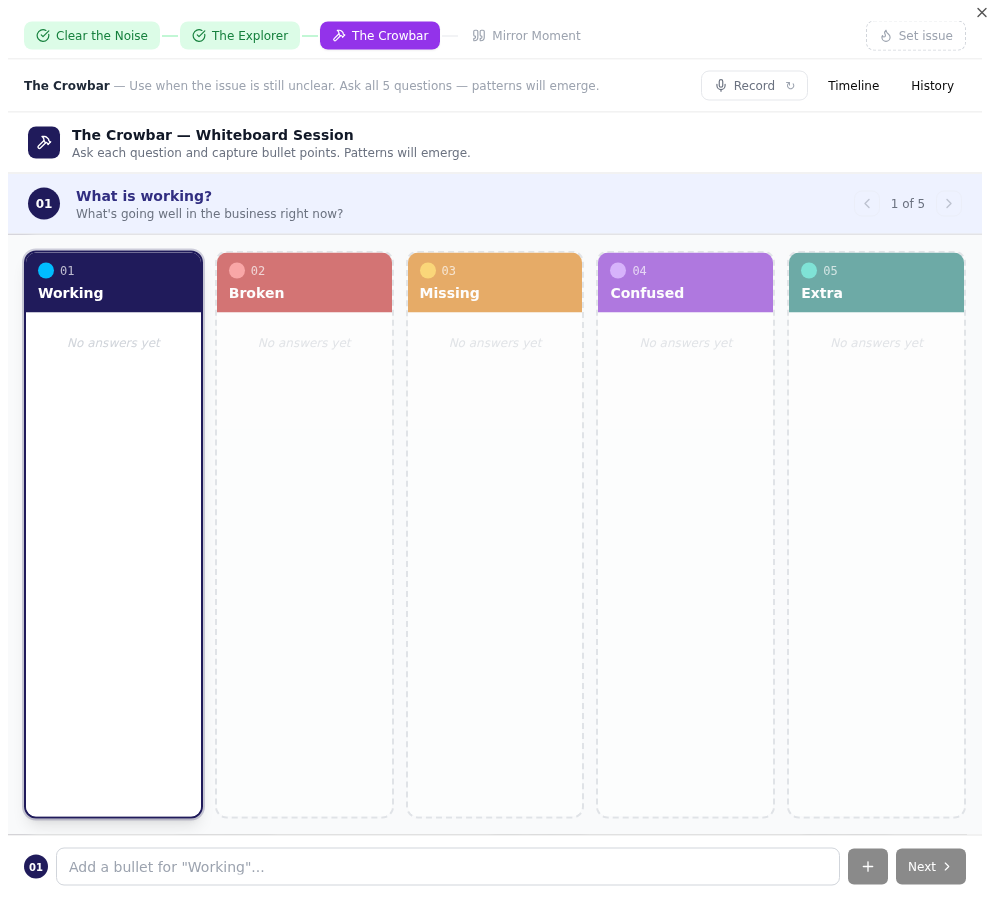
Advisor’s Guided Conversation provides prompts for that discussion. The Crowbar, for example, helps organize what is working, broken, missing, confused or extra. Use the questions to listen and narrow the issue, not force the client into a diagnosis you already chose.
3. Investigate the cause, then choose the relevant analysis
Cash pressure is the starting point, not the explanation. Review whether the pressure is coming from customer payment timing, inventory, margins, debt payments or another driver. Verify what the financial information suggests with the owner.
If overdue customer invoices are the issue, use the relevant working-capital analysis. If the question is whether the business can carry a future commitment, use the appropriate cash-planning or scenario tool. You do not need to use every tool to deliver one useful meeting.
AI can help organize information and prepare starting points. You still verify the evidence, judge the options and approve the recommendation.
4. Agree on an action someone can actually take
For a collections issue, the first action might be to have the owner review overdue invoices with the person responsible for collections, identify disputes and confirm payment dates with selected customers. Record who will do it and when you will review progress.
Keep the distinction between an expected result and cash actually received. A promise to pay is not a bank deposit. Do not present a model’s suggested improvement as money the client has already recovered.
5. Record the action and send the agreed summary
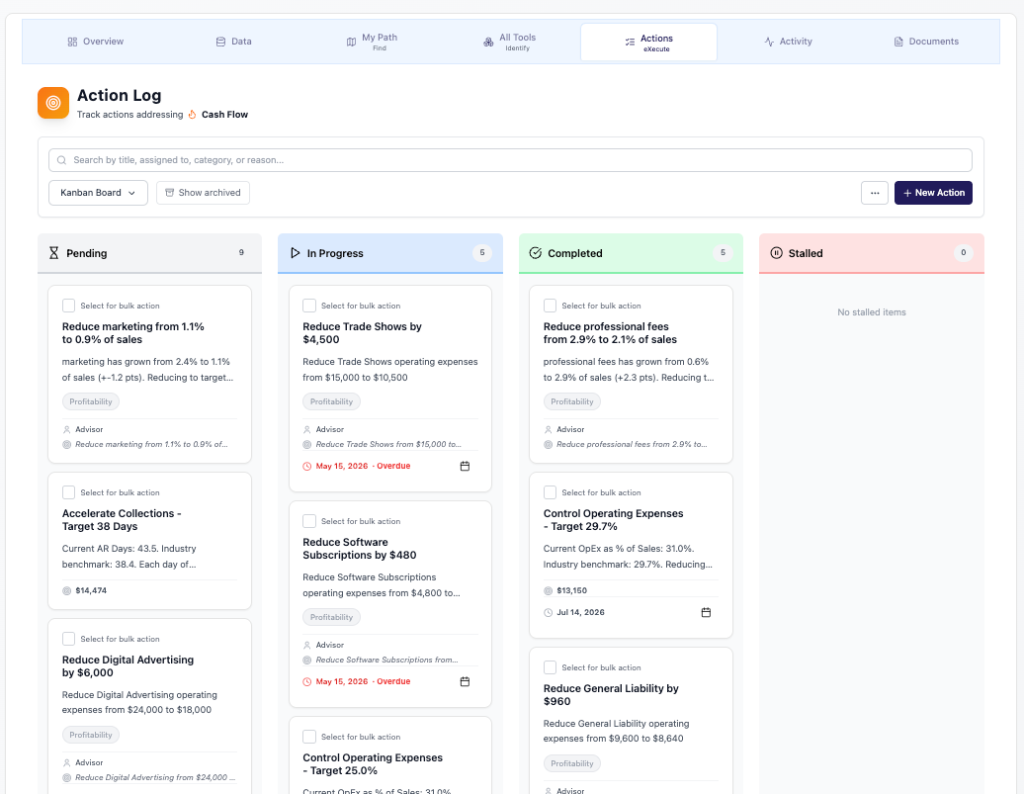
Advisor’s Action Log gives you a place to organize the follow-through rather than leaving it scattered across meeting notes. The screen below shows actions arranged by status. Use the agreed responsibility and review date to keep the next conversation specific.
Send the decision summary promised in your agreement through your normal client-delivery process. Include the evidence, chosen action, responsible person and review date. Your engagement letter and client summary are professional deliverables; do not assume a software screen replaces either one.
6. Use the next meeting to measure and learn
During the included check-in, ask whether the agreed work was done and what changed. At the next monthly meeting, compare expected collections with actual receipts, review unresolved items and decide whether to continue, revise or investigate something else.
Also review your own delivery. Did the package stay inside its scope? Did you have the capacity? If a new project emerged, discuss it separately before doing it. That is how a recurring engagement becomes repeatable instead of becoming an unlimited job.
Put the workflow into practice with Advisor
Knowing what to charge is only part of the job. You also need a dependable way to lead the conversation after the client says yes.
Explore Clear Path To Cash Advisor Membership for the method, education, live support and advisory tools that help you put that work into practice. For the workspace used in this walkthrough, see the Advisor platform or start the advertised 7-day free trial. The trial entry takes you to account sign-in or signup; check the current terms there.
Use this guide to draft one bounded service. Then practice the conversation, analysis and action review that make the service worth delivering. The tools support your judgment. They do not set your client’s fee or do the relationship work for you.
A specific example to share
Discussing advisory in a podcast, team meeting or training session? Link directly to the $900 monthly scope and fee example or the first-month delivery walkthrough.
Suggested show-note or training-resource description: How to Package and Price Cash Flow Advisory Services: a sample monthly scope, a worked fee example and the steps to take after a client says yes.
Try the AI-powered Clear Path to Cash® 7-Day Free Trial.
Start a 7-Day Free Trial of the AI-powered Clear Path to Cash® system, preloaded with a sample company so you can explore how it works in real advisory moments.
No credit card.
No setup.
No sales pitch.
Just hands-on access to the system advisors use when clients are waiting for direction.


Mike Milan
Founder, Cash Flow Mike

