
The Advisory Framework Every Accountant Needs When Client Meetings Go Everywhere
A couple of months ago, I was sitting in one of our weekly coaching sessions when one of our members asked me a question I had not really thought about before.
He said, “Mike, when did you know you had a framework?”
I laughed a little because I honestly could not remember sitting down and deciding to create one.
The more I thought about it, the more I realized I had been following the same path with clients for years. I just wasn’t calling it a framework.
So I asked him why he wanted to know.
He told me he had three different client meetings the week before.
Each one felt different: a different business, a different owner, and a different problem.
Different business.
Different owner.
Different problem.
By Friday afternoon, he felt worn out. The hours weren’t the issue. He had not worked some crazy week. The problem was that every client meeting felt like he had to rebuild the conversation from scratch.
That is what got my attention.
Because that is exactly where a lot of accountants, bookkeepers, and advisors get stuck when they start moving deeper into advisory work.
They know the numbers.
They understand the financial statements.
They care about helping the client.
Then the meeting starts, the client brings in whatever has been sitting in their head all week, and suddenly the conversation can go anywhere.
That is where a client advisory framework becomes useful. It does not give you a script; it gives the conversation a path.
The manufacturing client meeting that went everywhere
I asked him to tell me about one of the meetings.
He picked a manufacturing client.
The owner came in wanting to talk about cash. Payroll had been getting tighter over the last few months, and that was the issue that brought him into the meeting.
At least, that was where the meeting started.
A few minutes later, they were talking about inventory.
That made sense because inventory had been growing, and cash was tied up there.
Then pricing came up because one of the owner’s competitors had recently lowered prices.
That also made sense.
A little later, they were talking about whether the owner should delay buying another piece of equipment.
Again, reasonable topic.
The problem was not that any of these topics were wrong.
The problem was that the meeting had moved from cash to inventory to pricing to equipment without ever clearly landing on what mattered most.
When he finished telling me the story, I asked him a simple question.
“When you walked out of the room, what did you think the meeting was about?”
He stopped for a second.
Then he smiled and said, “I don’t know. I honestly can’t tell you.”
That is a real advisory problem.
It is also a very common one.
Business owners do not bring organized problems into the meeting
Business owners do not usually walk into your office with their problems neatly sorted into accounting categories.
They do not say:
“Today I would like to discuss working capital, inventory velocity, competitive pricing pressure, and capital expenditure timing.”
That would be nice.
That is not how most business owners talk.
They walk in carrying pressure.
Sometimes they say, “Cash feels tight.”
Sometimes they say, “I don’t know if we should buy the equipment.”
Sometimes they say, “Sales are fine, but I don’t like how this feels.”
Sometimes they start with one issue and then jump to another because, in their mind, it all feels connected.
And sometimes it is connected.
That is what makes advisory conversations tricky.
When every direction seems reasonable, the advisor can end up chasing the conversation instead of leading it.
I have done that more times than I would like to admit.
Early in my career, I thought being a good advisor meant answering every question the client asked.
Over time, I started seeing something different.
The advisors I respected most were not trying to answer every question in the room as fast as possible. They were trying to figure out which question actually mattered first.
That takes a different kind of discipline.
Why advisory meetings feel exhausting without a framework
A compliance meeting usually has a clear purpose.
The return is done.
The books are reviewed.
The report gets delivered.
The work has a defined shape.
Advisory meetings do not always feel that clean.
The client may begin with cash pressure, move to payroll, then equipment, then pricing, then hiring. If the advisor has no advisory workflow, the meeting can feel like a mental wrestling match.
You listen, take notes, answer questions, explain what you see, and try to keep up.
Then you leave the meeting with a page full of issues and no clean sense of priority.
That is exhausting.
It also makes the advisor less confident in the next meeting because they know how easy it is for the conversation to get wide again.
A good advisory framework for accountants solves that by helping the advisor organize the conversation while it is happening.
The framework gives the advisor a place to start, a way to listen, and a way to move toward action without turning the meeting into a lecture.
Experienced advisors already use patterns
When you have been doing advisory work for a long time, experience carries you farther than you realize.
You start noticing patterns.
You hear a business owner say cash is tight, and you know you may need to look at receivables, inventory, margins, debt, or expenses.
You hear a client talk about pricing pressure, and you start thinking about gross profit and capacity.
You hear a client talk about equipment, and your brain starts running through financing, cash runway, production capacity, and payback.
Experienced advisors do this naturally.
The problem is they often do it unconsciously.
That makes it hard to teach.
It also makes it hard to scale inside a firm.
One senior advisor may know how to move through a messy conversation because they have had hundreds of them. A newer advisor may understand the numbers and still freeze when the client says, “What should we do next?”
That is why the framework matters.
It turns experienced thinking into a repeatable advisory methodology.
The question that changed the conversation
During that coaching session, I grabbed a whiteboard and started drawing the path I usually follow with a client.
I realized I tend to do the same thing almost every time.
First, I try to understand where the client actually feels pressure.
That is not always the loudest problem.
The loudest problem may be the thing they complain about first. The real pressure may sit underneath it.
A client may complain about payroll, but the pressure may come from slow receivables.
A client may complain about pricing, but the pressure may come from poor gross profit.
A client may complain about cash, but the pressure may come from growth pulling too much working capital out of the business.
Once I understand where the pressure sits, I start looking for what is creating it.
That is where the numbers become useful.
The numbers help test the assumption.
They help us avoid guessing.
They help the advisor and client look at the same issue instead of talking around it.
Eventually, the conversation gets to the point where the advisor and client can talk about the next step.
That is where advisory starts to feel more grounded.
FIX: A simple advisory framework for accountants
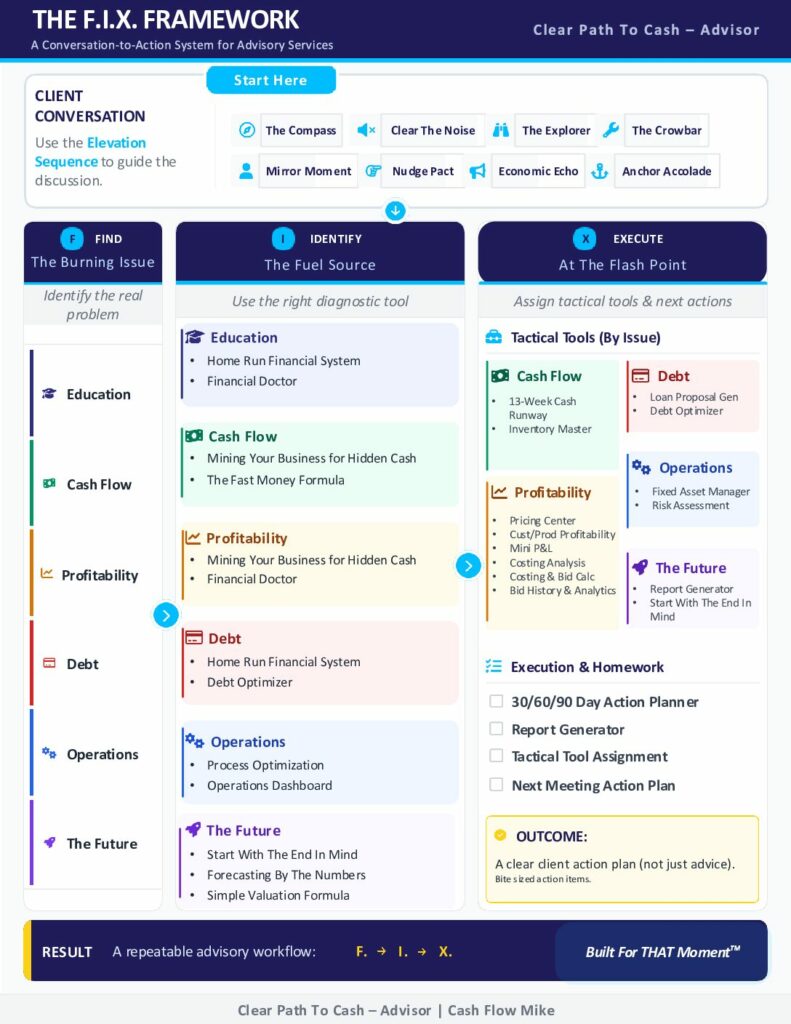
That path eventually became the FIX Framework inside Clear Path To Cash.
FIX stands for:
Find the Burning Issue.
Start with the pressure the client feels. Do not begin by unloading every problem you saw in the financials. The client’s pressure gives the meeting its starting point.
Identify what is causing it to burn.
Once you know the burning issue, use the numbers to find what is creating the pressure. This might point you to inventory, receivables, pricing, expenses, debt, working capital, or something else.
Execute the next step.
The meeting needs to move toward action. That does not mean solving the entire business in one conversation. It means deciding the next useful move and giving the client something clear to work on.
That sounds simple because it should be simple.
A framework that only works when everything is calm does not help much in real advisory work.
The advisor needs something they can remember when the client brings five different concerns into the room.
Why this advisory methodology works in real client conversations
The reason FIX works is that it matches the way business problems usually show up.
They do not arrive as perfect financial questions.
They show up as pressure.
The business owner feels something first.
Cash feels tight.
Payroll feels stressful.
Growth feels heavier than expected.
Pricing feels dangerous.
Inventory feels out of control.
The advisor’s job is to help the client follow that pressure back to the real financial driver.
That is a very different experience from explaining every issue you found.
The client does not need the full tour of every possible problem in the first ten minutes.
They need help understanding where to look first.
That is why a good advisory methodology for accountants does not replace judgment. It supports judgment.
It helps the advisor slow the meeting down enough to see what matters.
The advisor should not become a walking report reader
A lot of accountants and bookkeepers already have the trust of their clients.
The client sends them the books.
The client asks them questions.
The client expects them to understand what the numbers mean.
That puts the advisor in a powerful position.
It also creates pressure.
Because once the advisor moves from compliance into advisory, the client expects more than a report summary.
The client wants help making sense of the business.
Mike talks about this idea in The 7 Minute Conversation, where he explains that his CPA could do the math and work through the numbers, yet could not connect the financials to real life or point him in the right direction.
That is the gap advisors have to close.
A report can show what happened.
A framework helps the advisor lead the conversation about what to do next.
Why “more tools” can still leave the advisor stuck
Most advisors do not need another random dashboard.
They need a workflow that helps them decide what to do with what they see.
That distinction matters.
You can have twenty tools available and still feel stuck if you do not know which one belongs in the conversation.
That is one reason Clear Path To Cash was built around advisory thinking instead of a feature list.
The software supports the process an experienced advisor would use when a client brings a messy business situation into the room.
It helps the advisor move from the client’s pressure to the financial cause and then toward a clear action.
That matters because the strongest positioning for Clear Path To Cash has never been “more reports.” The core promise is confidence in live client conversations.
How the framework changes the manufacturing conversation
Go back to the manufacturing client.
The owner came in worried about cash.
Without a framework, the meeting moved into inventory, pricing, and equipment. Every topic made sense, yet the advisor left without a clear sense of what the meeting was actually about.
With FIX, the conversation would slow down.
The advisor would start with the burning issue.
The owner feels cash pressure.
Then the advisor would identify what is creating that pressure.
Is inventory tying up cash?
Are margins getting squeezed because of pricing pressure?
Is the new equipment decision going to make the cash position worse before it improves?
Are receivables creating a timing problem?
Those questions help narrow the room.
The advisor does not need to solve every issue at once.
They need to find the first issue that matters enough to act on.
From there, the meeting can move toward a next step.
Maybe they review inventory levels before making the equipment decision.
Maybe they run pricing scenarios before responding to the competitor.
Maybe they build a short-term cash forecast before payroll pressure gets worse.
That is what the framework gives you: a cleaner way to move through the conversation.
What accountants should look for in an advisory workflow
If you are building or improving your client advisory services, look for a workflow that helps you answer five practical questions:
- What pressure is the client feeling right now?
- What financial driver could be creating that pressure?
- Which number, trend, or pattern can help confirm it?
- What decision does the client need to make?
- What action should happen before the next meeting?
That is the work. It is not a longer report, a prettier dashboard, or a new label on the same monthly review.
The advisory workflow has to help you lead the conversation when the client is sitting there waiting for direction.
The framework helps newer advisors develop judgment
Experienced advisors may not feel how much they rely on pattern recognition.
Newer advisors feel it right away.
They can review the financials.
They can spot issues.
They can prepare notes.
Then the client asks a real-world question and the meeting gets messy.
That is when they need more than technical knowledge.
They need a structure that helps them think.
A strong advisory framework for accountants gives newer advisors a repeatable path until their own pattern recognition gets stronger.
It helps them avoid the feeling of, “I see three things, and I don’t know which one to talk about first.”
That sentence has shown up inside the Clear Path To Cash community because advisors are honest about what happens in real client meetings. One advisor described seeing several possible issues and feeling unsure which direction to coach the client toward. Mike’s answer was simple: start with the problem the client feels, then use the framework to identify what is creating the pressure.
That is exactly why this matters.
The framework also helps experienced advisors become more consistent
This is not just for new advisors.
Experienced advisors benefit because the framework makes their process more visible.
That helps in three ways.
First, it keeps client conversations from wandering.
Second, it gives the advisor a way to explain their thinking to team members.
Third, it creates a more consistent client experience across the firm.
That consistency matters if you want advisory services to grow beyond one person’s instinct.
A firm cannot scale “just use your judgment” very well.
It can scale a process.
Why this matters for firms moving from compliance to advisory
A lot of firms want to move from compliance to advisory.
That sounds good.
The difficult part shows up after the client meeting starts.
If the firm keeps running advisory conversations like report review meetings, clients may listen politely and still leave without a clear next step.
A real advisory conversation usually requires the advisor to help the client sort through pressure, identify what is creating it, and decide where to act.
That is why advisory training for accountants needs to include live conversation structure.
Technical knowledge matters.
The advisor also needs to know how to guide the meeting when the business owner brings in a problem that does not fit neatly into one report.
That is where the framework earns its keep.
Clear Path To Cash supports the advisor’s thinking process
Clear Path To Cash was not built to replace the advisor.
It was built to support the advisor.
That distinction matters.
The client still needs the advisor’s judgment, experience, and relationship.
The app gives the advisor a structured way to move through the conversation, use the right tool at the right time, and create action from what they find.
That is why the best way to understand it is not to stare at a feature list.
The best way is to bring a real client situation and watch the framework move.
A client worried about cash.
A client stuck on pricing.
A client wondering whether to buy equipment.
A client growing and still feeling tight.
Those situations show how the workflow works because they are the moments advisors actually face.
Bring one messy client meeting to the 7-Day Free Trial
If you have ever walked out of a client meeting and thought, “I’m not even sure what that meeting was really about,” you are not alone.
That is usually a sign that the conversation needed more structure.
Bring one real client situation to the Clear Path To Cash 7-Day Free Trial.
Bring the messy one, not a perfect one.
The one where the client started with cash, moved to inventory, brought up pricing, and then asked about equipment.
That is exactly the kind of moment this framework was built to support.
The Clear Path To Cash 7-Day Free Trial is available when you are ready.
Clear Path To Cash was built for the moment when a client conversation starts with one concern and keeps branching into others.
Advisor meeting-prep checklist
Before the next advisory meeting, prepare three things: the client’s stated pressure, the financial signal that could explain it, and the decision the client may need to make. Do not prepare a presentation for every possible topic. Prepare a path for testing what matters first.
- What does the client believe is urgent?
- Which period, account, or cash event can confirm or challenge that belief?
- What decision must be clearer by the end of the meeting?
- What is the smallest useful next action, and who owns it?
Use the canonical FIX sequence as the meeting spine: Find the Burning Issue, Identify the Fuel Source, and Execute at the Flash Point. These labels describe a decision workflow, not a promise that every client problem has one instant answer.


Try the AI-powered Clear Path to Cash® 7-Day Free Trial.

Start a 7-Day Free Trial of the AI-powered Clear Path to Cash® system, preloaded with a sample company so you can explore how it works in real advisory moments.
No credit card.
No setup.
No sales pitch.
Just hands-on access to the system advisors use when clients are waiting for direction.


Mike Milan
Founder, Cash Flow Mike

