
The Mirror Moment: How to Help Clients Finally See Their Financial Reality
If you’ve ever sat across from a client who nods politely while you explain their numbers but still doesn’t change a thing, you know the frustration.
You give them the analysis. You outline the solutions. You hand over the playbook. And yet, nothing happens.
It’s not that they don’t trust you. It’s not that they don’t care.
The problem is deeper: They haven’t seen it for themselves yet.
In my years of working with business owners, accountants, and financial advisors, I’ve learned that the most powerful moment in any client conversation isn’t when I explain the numbers. It’s when the client has their Mirror Moment, that split second where they truly see the problem in their own business, acknowledge it out loud, and are ready to act.
What Is a Mirror Moment?
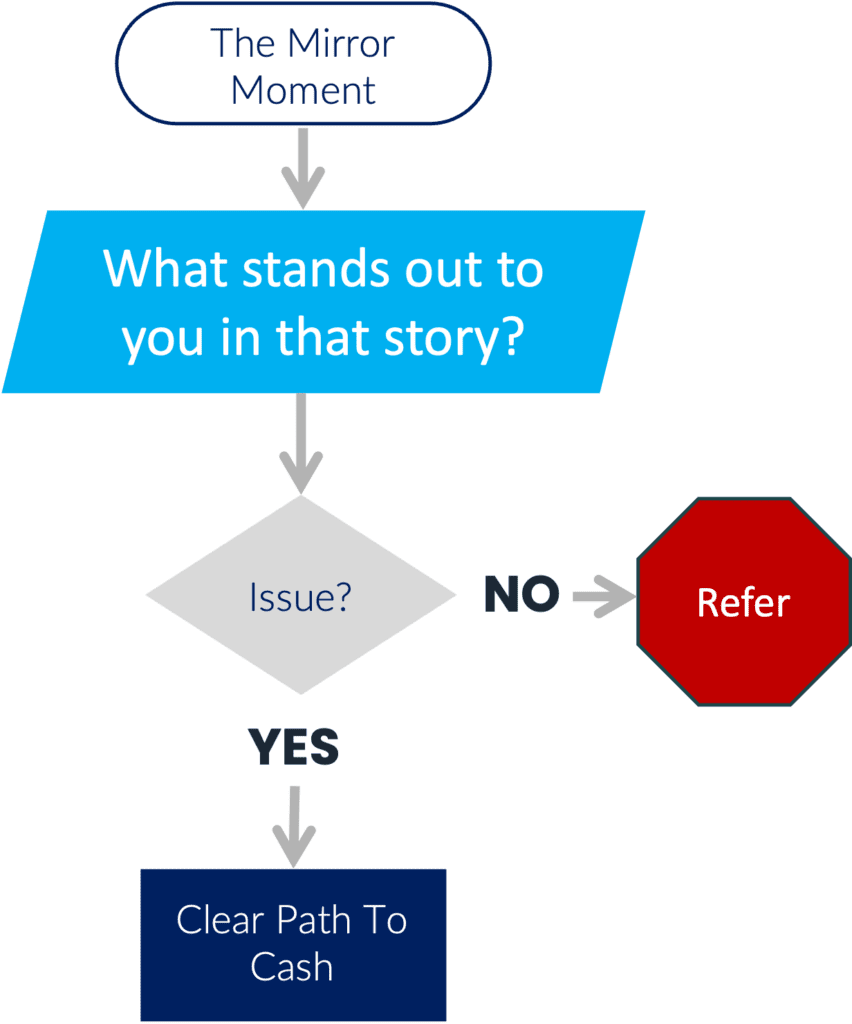
A Mirror Moment is the point in an advisory conversation when the client recognizes a financial truth for themselves.
They move from passive listener to active participant.
They stop asking, “What should I do?” and start saying, “Here’s what I need to fix.”
When that happens, you’ve unlocked their buy-in. And buy-in is the difference between ignored advice and immediate action.
The Story That Changed How I Work With Clients
A few years ago, I was meeting with Jim, the owner of a mid-sized construction company in Texas. Jim was a good operator with strong sales and plenty of jobs on the books, but his cash flow was a constant problem.
We went through our usual process: reviewing his profit and loss statement, checking his cash flow report, and comparing his numbers to industry benchmarks.
At first, Jim was in “review mode,” nodding as I pointed out trends and ratios. But then I asked him:
“When you look at these numbers, what’s the one thing that jumps out at you?”
He paused. Really paused.
Then he pointed to his cost of goods sold and said:
“Why is that so high?”
That was it, the Mirror Moment. He had just seen the problem.
Not because I told him. Because he spotted it himself.
From that point forward, the conversation shifted. He wanted to dig into vendor terms. He was open to raising prices. He cared about tracking inventory turnover.
And most importantly, he followed through.
Why Mirror Moments Work
Mirror Moments work because they flip the dynamic.
Instead of you doing the diagnosing, the client becomes the one identifying the pain point. And when people diagnose their own problem, they are:
- More motivated to fix it (it’s their problem now)
- More open to change (because they “discovered” the insight)
- More confident in your guidance (you didn’t push it—they pulled it)
How to Create Mirror Moments in Your Client Conversations
If you want more clients to act on your advice, you need to engineer moments where they uncover the problem themselves. Here’s how to do it:
1. Start With an Open Question
Skip the lecture and start with:
- “What’s been going on in your business this week?”
- “Looking at these numbers, what’s the first thing you notice?”
- “If you could change one thing in your business right now, what would it be?”
These questions clear the noise and invite honest reflection.
2. Use Visual Tools
People process data faster when they can see it. Tools like the Cash Leak Map or Financial Gap Map make inefficiencies obvious without you having to point them out.
When they see a bar graph where one red line towers over the rest, they can’t ignore it.
3. Pause for Silence
After asking the question, stop talking.
Give them time to process. That moment of quiet is where the realization happens.
4. Let Them Say It Out Loud
Once they name the issue themselves, repeat it back:
“So, you’re saying vendor costs are too high?”
This locks the insight in place and creates ownership.
5. Move to Action Immediately
Mirror Moments are fragile; if you wait, the urgency fades.
Go straight into scenario planning:
- “What would happen if we improved this ratio by 5%?”
- “Let’s model what a price increase would do to your cash flow.”
The Clear Path to Cash Approach
At Clear Path to Cash, we teach advisors, accountants, and business owners how to engineer these Mirror Moments consistently. It’s built into our framework:
- Start With the End in Mind – Define what success looks like for the client.
- The Home Run Financial System – Understand the business in 7 minutes or less.
- Mining Your Business for Hidden Cash – Reveal quick wins.
- The Fast Money Formula – Shorten the cash conversion cycle.
- Forecasting by the Numbers – Plan with clarity.
- How to Deal With Your Banker – Build financing confidence.
- The Simple Valuation Formula – Track transferable value.
- The Deliberate Exit Strategy – Align financials with future goals.
Mirror Moments happen naturally when you combine the right questions with these tools.
Why This Matters Now
In 2025, small business owners face more pressure than ever: rising costs, tight labor markets, and unpredictable cash flow.
The businesses that survive and thrive will be the ones whose leaders:
- Understand their numbers
- Can spot problems early
- Act quickly on solutions
As an advisor or owner, your job isn’t just to “know the numbers.” It’s to help others see them.
Your Next Step
If you want to watch Mirror Moments happen in real time, join me for my next Live Call-In Show. You’ll see exactly how I guide business owners to discover their own financial truths, and you’ll walk away with practical techniques you can use immediately.


Try the AI-powered Clear Path to Cash® 7-Day Free Trial.

Start a 7-Day Free Trial of the AI-powered Clear Path to Cash® system, preloaded with a sample company so you can explore how it works in real advisory moments.
No credit card.
No setup.
No sales pitch.
Just hands-on access to the system advisors use when clients are waiting for direction.


Mike Milan
Founder, Cash Flow Mike

