
Meet Cash Flow Mike: The Four Laws That Turn Financial Reports Into Better Decisions
A business owner walks into a meeting with a profit-and-loss statement, a cash balance, and a question:
“We look profitable. Why is cash still tight, and can we afford to hire?”
The financial reports can show what happened.
They cannot decide what the owner should do next.
That gap between accurate information and useful direction is where I have spent much of my career.
As Cash Flow Mike, I help accountants, bookkeepers, fractional CFOs, business advisors, and small business owners move beyond reporting the numbers and into making better financial decisions.
The goal is not to make an advisor sound smarter in a meeting.
The goal is to make the advisor more useful when the answer is not obvious and the client is waiting for direction.
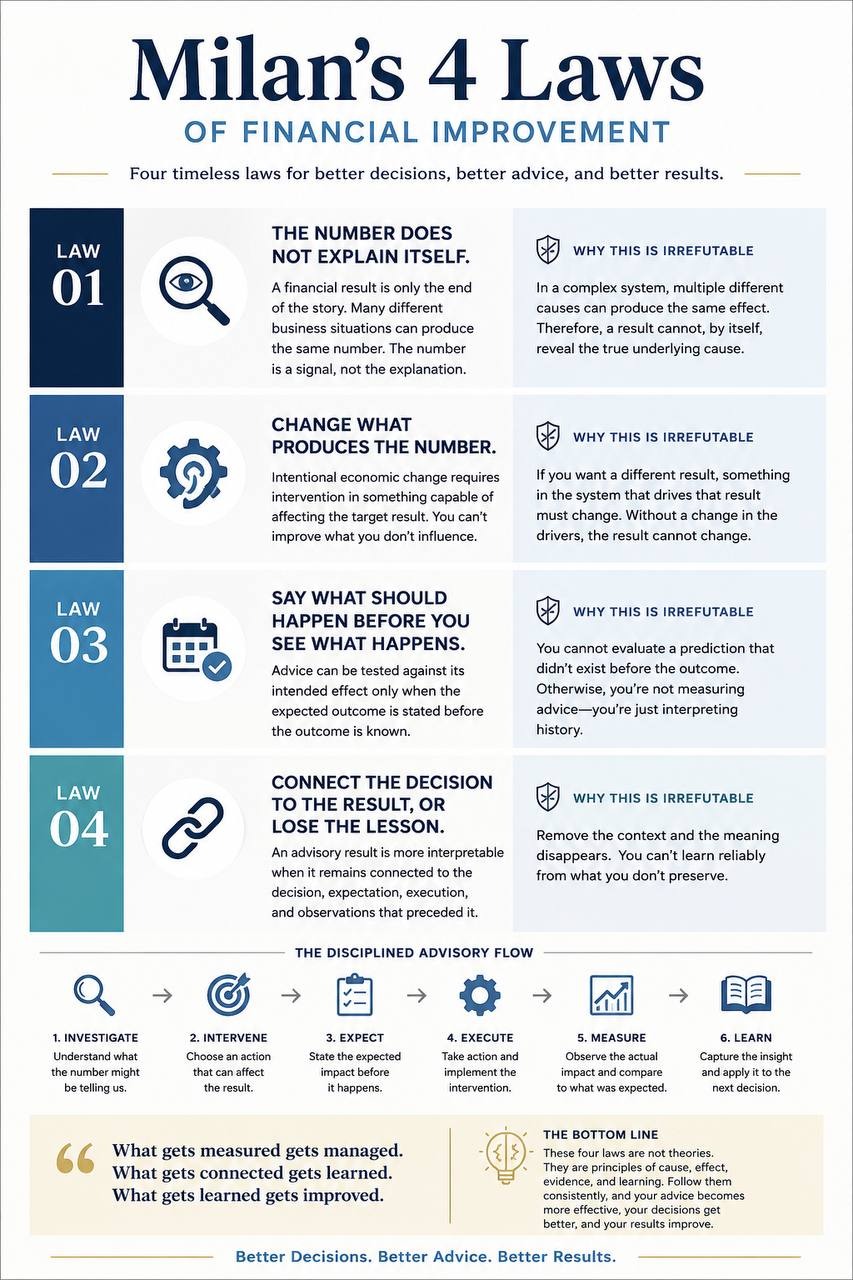
That is the thinking behind Milan’s Four Laws of Financial Improvement.
I learned the difference between profit and cash the hard way
My interest in cash flow did not begin as a branding exercise.
Years ago, I helped scale a fast-growing business. On paper, things looked successful. Revenue was growing. The business appeared profitable.
Then we reached a point where we did not have enough cash to make payroll.
I maxed out credit cards and used a home equity loan to keep the business alive.
That experience changed the way I looked at financial statements.
A profitable business can still run out of cash.
Revenue, profit, receivables, inventory, expenses, debt, and timing all tell part of the story. But no individual number tells the entire story.
I began studying the mechanics of cash flow because I needed to understand what was happening inside my own business. Eventually, that work grew into the methods I now teach through Cash Flow Mike and Clear Path To Cash®.
And along the way, one lesson became increasingly clear:
Knowing the number is only the beginning.
The moment financial reporting becomes financial advisory
Financial technology has become very good at organizing information.
Dashboards calculate ratios.
Accounting systems produce reports.
Forecasts model different possibilities.
Artificial intelligence can analyze large amounts of information in seconds.
Those capabilities are valuable.
But eventually, the business owner looks across the table and asks:
“What should we do?”
Can we afford to hire?
Should we borrow money?
Why are we profitable but short on cash?
Are receivables really the problem?
Should we increase prices?
Is inventory tying up too much money?
Which issue should we work on first?
This is the moment I describe as Built For That Moment™ — the point where reporting ends and a real business decision begins.
Good advisory work requires more than identifying an unusual number. It requires a disciplined way to move from information to action.
That is what Milan’s Four Laws are designed to provide.
Milan’s Four Laws of Financial Improvement
The Four Laws are simple enough to remember, but together they create a powerful way to think about financial improvement.
First Law: Explanation
The number does not explain itself.
Imagine that accounts receivable suddenly increases.
It is tempting to immediately conclude:
“Collections are getting worse.”
Maybe.
But receivables could also increase because sales grew rapidly.
Invoices may have gone out late.
Payment terms may have changed.
One large customer could now represent a bigger share of sales.
Or the business could have intentionally extended terms to win an important account.
Same number. Different explanation.
That distinction matters because different explanations require different actions.
Financial statements provide evidence. They give us clues about where to look.
But the number alone does not tell us why something happened.
Before prescribing a solution, the advisor needs to ask questions, understand the business, and investigate what is actually happening.
The First Law:
Do not assume. Investigate before prescribing.
Second Law: Intervention
Change what produces the number.
Finding the problem is not the same as fixing the problem.
Suppose a company has too much cash tied up in inventory.
Talking about the inventory ratio again will not improve cash flow.
Creating another dashboard will not improve cash flow.
Setting a goal to “reduce inventory” will not improve cash flow by itself.
Something in the business has to change.
That might involve purchasing practices, reorder quantities, product mix, obsolete inventory, sales activity, supplier relationships, or another operating decision.
The important question is:
What can we actually change that has a reasonable connection to the result we want?
The same applies throughout a business.
If margins are weak, something affecting price, cost, mix, or productivity may need to change.
If receivables are slow, something in billing, terms, collections, or customer behavior may need to change.
If cash is tight, the advisor needs to identify which business activities are creating that pressure.
An intervention does not guarantee success.
It simply means we are working on something capable of influencing the result instead of hoping the number changes on its own.
The Second Law:
Change something capable of producing the desired effect.
Third Law: Expectation
Say what should happen before you see what happens.
Suppose an advisor recommends raising prices.
Or changing the collection process.
Or reducing an inventory category.
Or renegotiating supplier terms.
Before implementing the decision, there is an important question:
What do we expect to happen?
That question forces clarity.
If we cannot explain what we reasonably expect the action to accomplish, we may not understand the recommendation as well as we think we do.
The expectation does not need to be perfect.
Business is not a laboratory.
There are customers, competitors, employees, economic changes, surprises, and hundreds of other variables we cannot completely control.
But we should still define what success is supposed to look like before we know the result.
Maybe collections should improve.
Maybe margin should increase without materially reducing sales.
Maybe inventory should decline while service levels remain acceptable.
Maybe the company should generate enough additional cash to support a planned hire.
The purpose is not to predict the future perfectly.
The purpose is to make the reasoning testable.
Otherwise, after the fact, almost any result can be explained away.
The Third Law:
Define what success should look like before judging the result.
Fourth Law: Traceability
Connect the decision to the result, or lose the lesson.
Businesses make decisions every day.
The problem is that many of those decisions eventually disappear into meeting notes, email threads, spreadsheets, or memory.
Months later, someone notices that a number improved or got worse.
Then the questions begin.
What did we decide?
Did we actually do it?
What were we trying to accomplish?
What else changed during that period?
Did the decision work?
Without context, it becomes difficult to learn much from the result.
That is why follow-through matters.
A recommendation should not disappear when the meeting ends.
The advisor should continue the conversation:
What did we decide?
What actually happened?
What changed?
What did we learn?
And what should we do next?
That also helps separate two situations that are often confused.
A poor recommendation and poor execution are not necessarily the same thing.
A good idea can be executed poorly.
A reasonable decision can produce an unexpected result.
And occasionally, a questionable decision can appear successful because something else changed at the same time.
Advisory work requires enough context to understand the difference.
The Fourth Law:
Stay connected to the decision long enough to learn from the result.
From financial information to financial improvement
Together, the Four Laws create a simple discipline:
Investigate → Intervene → Expect → Execute → Measure → Learn → Repeat
First, investigate what the financial information may be telling you.
Then identify something in the business that can actually change.
Decide what you reasonably expect that change to accomplish.
Take action.
Measure what happened.
Learn from the experience.
Then bring what you learned into the next conversation.
That is how financial advisory becomes more than a series of meetings.
It becomes a repeatable process for improvement.
The system around the Four Laws
The Four Laws provide the principles behind the work.
I have developed other methods to help financial professionals apply those principles with real clients.
The F.I.X. Framework helps advisors move from the client's primary concern toward the financial and operational issues that deserve attention.
Clear Path To Cash® gives advisors financial tools, methodologies, education, and a working environment for turning analysis into meaningful client conversations.
Together, the goal is straightforward:
Help advisors move from explaining what happened to helping clients decide what happens next.
Why the Four Laws matter even more in the age of AI
Artificial intelligence is going to make financial analysis faster.
It can identify patterns.
Summarize information.
Calculate scenarios.
Generate questions.
Suggest possibilities.
Those capabilities will continue to improve.
But faster analysis does not eliminate the need for sound advisory judgment.
A recommendation still has to make sense for the particular business.
The advisor still needs to understand the owner's priorities.
Someone still has to decide what action is appropriate.
And someone still has to come back later and ask:
What happened?
That is why I do not see AI replacing good advisors.
I see AI increasing the value of advisors who know how to use information well.
The competitive advantage will not simply be having access to more numbers.
Almost everyone will have that.
The advantage will be knowing how to turn those numbers into better questions, better decisions, better conversations, and ultimately better outcomes.
Who is this work for?
Cash Flow Mike is for the accountant who is tired of simply reading financial statements aloud.
It is for the bookkeeper whose clients have started asking bigger questions.
It is for the fractional CFO who wants a repeatable way to guide decision-making.
It is for the business advisor who wants financial conversations to lead somewhere.
And it is for business owners who have learned that profit and available cash are not the same thing.
If you have ever been sitting across from a client when they asked:
“Okay, I understand the numbers. What should I do now?”
You have reached the moment I built this work for.
Meet Cash Flow Mike by using the work
The simplest way I can explain what I teach is this:
Finish the thought.
Do not stop at:
“Receivables increased.”
Ask why.
Do not stop at:
“Margins declined.”
Ask what can change.
Do not stop at:
“We should try this.”
Ask what success should look like.
And do not stop after the client takes action.
Come back and ask what happened.
A financial report tells you what happened.
Good advisory work helps the client investigate why, decide what could change, take action, and use the experience to make the next decision better.
That is Milan’s Four Laws of Financial Improvement.
And that is what it means to be Built For That Moment™.
See Clear Path To Cash® in action
Clear Path To Cash® helps financial professionals move beyond reporting and into structured advisory conversations using more than 25 financial and advisory tools.
The 7-Day Free Trial includes a sample company, so you can explore the system without uploading client information or entering a credit card.
Start Your 7-Day Free Trial
Good advice uses evidence. Great advice helps you make the next decision better.
Mike Milan
Founder, Cash Flow Mike
Creator of Clear Path To Cash®
See how Clear Path To Cash supports the next decision.
The 7-Day Free Trial is preloaded with a sample company. You can explore the system without uploading client data, entering a credit card, or configuring an account.
Good advice uses evidence. Great advice leaves evidence.